On 1 January 1973 Nigeria carried out the most successful currency reform in its history. The Nigerian pound (₤N) — itself only fourteen years old, having replaced the West African Currency Board pound in 1959 — was retired alongside the colonial £-s-d duodecimal system. In its place came the naira (₦) and kobo, a decimal currency at 100 kobo to the naira and a conversion rate of £1 = ₦2 (so one shilling = 10 kobo).
The reform had been recommended by the 1962 Decimal Currency Committee under Chief Festus Okotie-Eboh, deferred by the civil war, and finally executed by the Gowon government's Finance Commissioner Shehu Shagari — later President of the Second Republic. The name 'naira' is a contraction of 'Nigeria', proposed by Obafemi Awolowo while he served as Federal Commissioner for Finance (1967–71); 'kobo' is the Hausa word for the British penny. The denominations issued on 1 January 1973 were 50 kobo, ₦1, ₦5, ₦10 and ₦20 (the ₦20 was added in 1977 and became the largest note for two decades), and coins of ½k, 1k, 5k, 10k and 25k. The new notes carried portraits of agricultural and industrial scenes rather than the Queen's head that had survived on the Nigerian pound until 1965.
For twelve months the old pound notes circulated alongside the naira at the fixed 2:1 rate; from 1 January 1974 the pound ceased to be legal tender. The reform was administered by the Central Bank of Nigeria under Governor Clement Isong and is still cited by the CBN as a model exercise in currency management. The naira's subsequent collapse — from ₦0.55 to the US dollar in 1980 to over ₦1,500 in 2024 — is the longer story; see The Central Bank of Nigeria and Currency.
The money itself
Archival illustrations commissioned for this archive — format, palette and motif of each issue, not a photograph or facsimile.
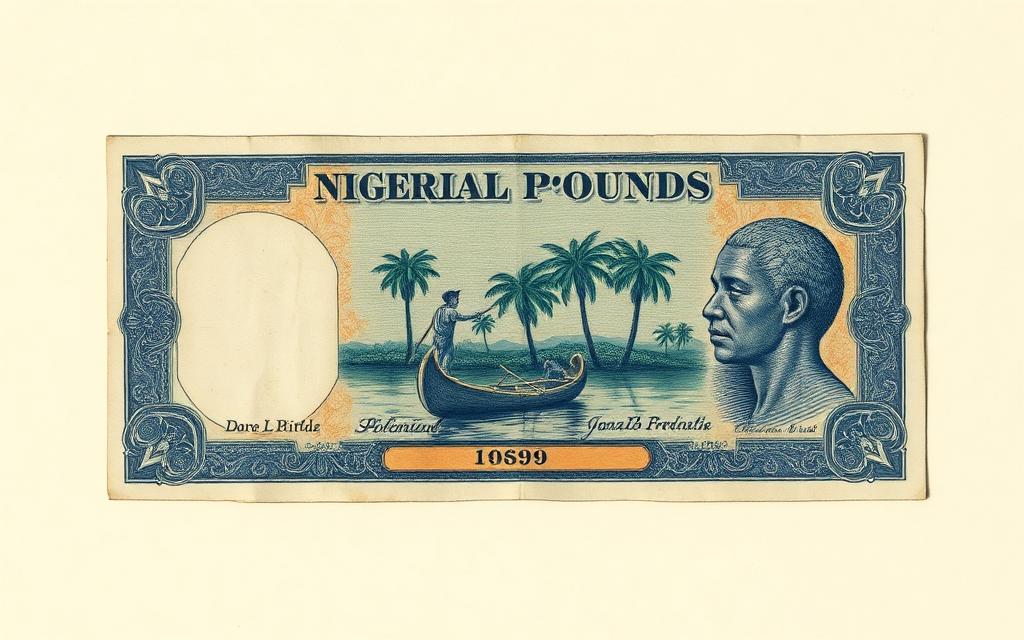
1 July 1959 — 31 December 1972
Nigerian pound
The first currency issued by the Central Bank of Nigeria, replacing the WACB pound at par.
What it bought
A new Volkswagen Beetle landed in Lagos in 1962 cost about ₤500.
Worth today
₤1 of 1959 ≈ ₦27,000 in 2026 money.
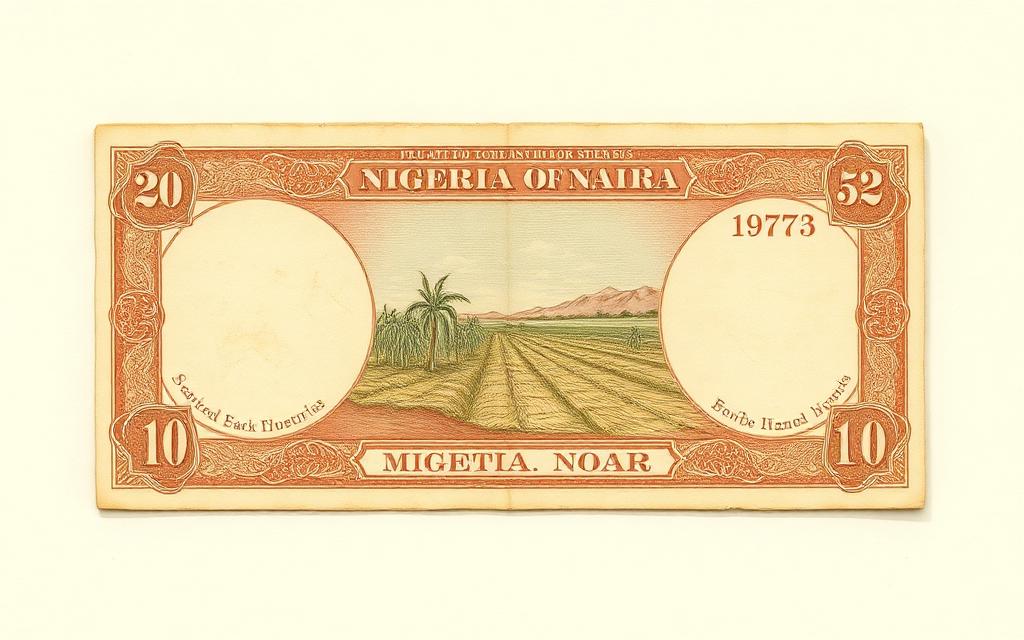
1 January 1973
The first naira
50k, ₦1, ₦5, ₦10 — decimal, agricultural motifs, and no Queen's head. Named by Awolowo, from 'Nigeria'.
What it bought
₦1 in 1973 bought roughly 16 litres of petrol, or twenty loaves of bread.
Worth today
₦1 of 1973 ≈ ₦7,010 in 2026 money.
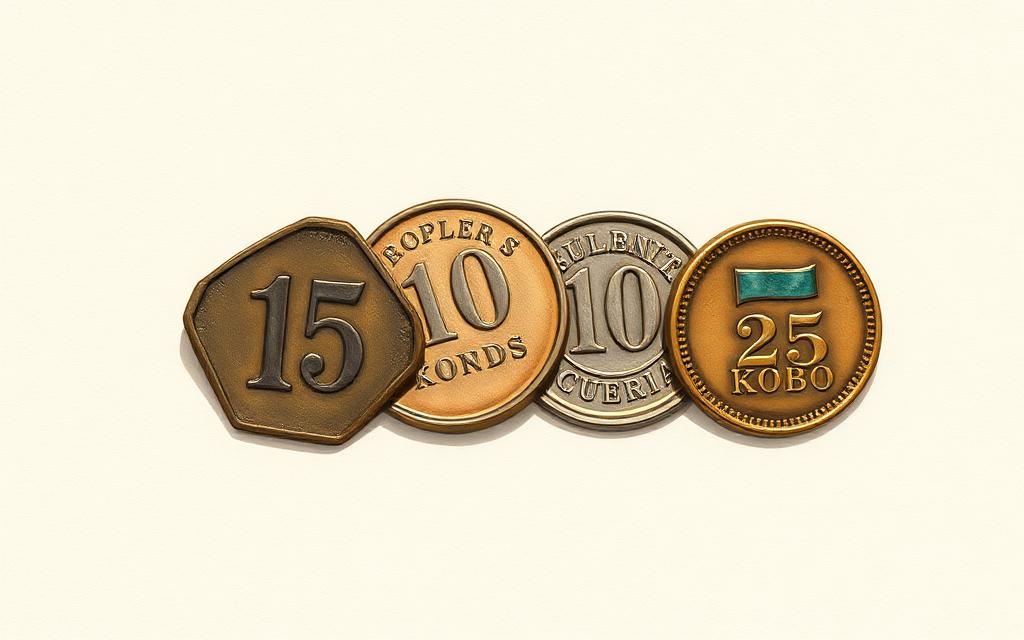
1 January 1973 — effectively extinct
Kobo coins
½k, 1k, 5k, 10k and 25k, struck in bronze and cupro-nickel. 'Kobo' is the Hausa word for the British penny.
What it bought
5 kobo bought a bottle of soft drink in 1973.
Worth today
No kobo coin has circulated meaningfully since the mid-1990s. The unit survives only in accounting.