Listen to this entry0:00 / —:—
The ₦1,000 note was issued on 12 October 2005 featuring Aliyu Mai-Bornu and Clement Isong, the first two indigenous Governors of the Central Bank. Reverse: CBN Headquarters, Abuja.
Higher Denom2005· Obasanjo II· Chapter I · Money
Issued 12 October 2005. Aliyu Mai-Bornu and Clement Isong — the first two Nigerian CBN Governors.
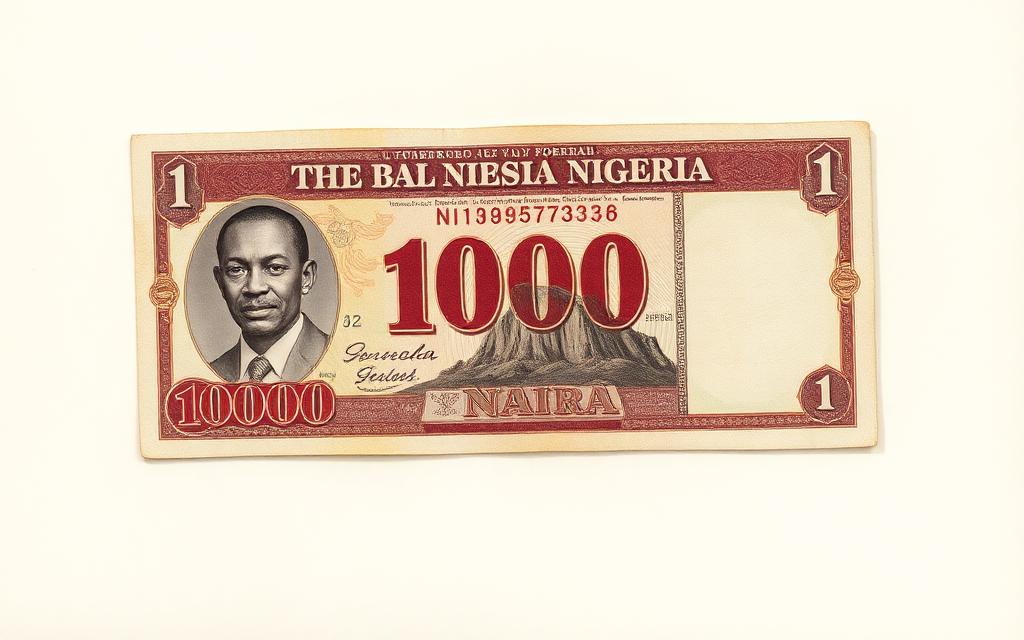
12 October 2005
Aliyu Mai-Bornu and Clement Isong — the first two Nigerian Governors of the Central Bank — on the obverse.
What it bought
₦1,000 in 2005 filled a car's tank with 15 litres to spare.
Worth today
₦1,000 of 2005 ≈ ₦15,800 in 2026 money. It remains the largest note in circulation.
The ₦1,000 note was issued on 12 October 2005 featuring Aliyu Mai-Bornu and Clement Isong, the first two indigenous Governors of the Central Bank. Reverse: CBN Headquarters, Abuja.
What it cost — political & economic reality
Nigeria in 2005: who was in charge, the cabinet of the day, the GDP, and the crises that defined the period.
President · Fourth Republic
1999–2007· PDP
National reality
Return to civilian rule, 29 May 1999. Telecoms deregulation (2001) — GSM revolution. Paris Club exit, October 2005 ($30 bn debt relief, Okonjo-Iweala). Pension Reform 2004. EFCC established 2003.
Crises of the period
GDP (World Bank)
$59 bn (1999) → $166 bn (2007)
Cabinet (selected portfolios)
Adamu Ciroma (1999–2003); Ngozi Okonjo-Iweala (2003–06)
Tunde Adeniran; Babalola Borishade; Fabian Osuji; Chinwe Obaji; Oby Ezekwesili
Prof. ABC Nwosu
Sources · Federal Gazette 1999–2007 · CBN · World Bank WDI
Tier 1 · primary
Courts. Gazettes. National archives.
Tier 2 · corroborating
OCCRP. HRW. BudgIT. TheCable.
Tier 4 · tertiary, flagged
Wikipedia only where primary is pending. Always labelled.