The Republic
Currency History

First Redesign1979· 5k–₦20· Chapter I · Money

New naira notes featuring nationalist figures

Notes redesigned to feature Tafawa Balewa, Azikiwe, Awolowo, Ahmadu Bello. ₦20 introduced — first ₦20 note ever.

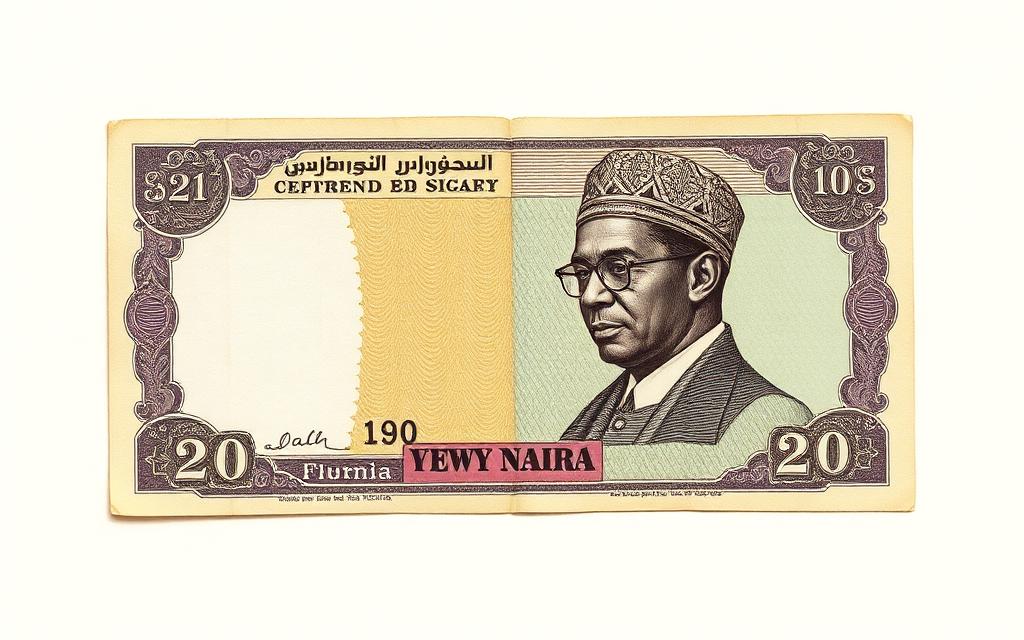
Archival illustration of a 1980s Nigerian twenty naira banknote

11 February 1977 series; ₦20 issued 1981

₦20

The first Nigerian note to carry a Nigerian face — Murtala Muhammed — and the highest denomination for a decade.

What it bought
₦20 in 1981 was about a week's wage for a junior clerk.

Worth today
₦20 of 1981 ≈ ₦38,000 in 2026 money.

Listen to this entry0:00 / —:—

On 11 February 1977 the CBN announced a new series featuring Sir Abubakar Tafawa Balewa (₦5), Dr Nnamdi Azikiwe (₦10), Chief Obafemi Awolowo (₦20 — issued 1981) and Sir Ahmadu Bello (later additions). The ₦20 introduced in 1981 was at the time the highest denomination ever issued in Nigeria.

What it cost — political & economic reality

The political and economic reality

Nigeria in 1979: who was in charge, the cabinet of the day, the GDP, and the crises that defined the period.

Head of State · Military

Gen. Murtala Muhammed → Gen. Olusegun Obasanjo

1975–1979

National reality

Murtala assassinated 13 February 1976; Obasanjo completed the transition. Universal Primary Education launched 1976. Land Use Act 1978. 1979 Constitution and handover to the Second Republic.

Crises of the period

  • Dimka coup attempt + Murtala assassination (1976)
  • 'Ali Must Go' student protests (1978) — students killed over a 50-kobo fee increase

GDP (World Bank)

$28 bn (1975) → $47 bn (1979)

Cabinet (selected portfolios)

  • Education

    Col. Ahmadu Ali (1975–78)

  • Education

    J.O.J. Okezie (1978)

Sources · Federal Gazette · Constitution Drafting Committee records (1976–78)

President · Second Republic

Alhaji Shehu Shagari

1979–1983· NPN

National reality

First executive presidency. Oil-price crash from 1981 destroyed the boom. Ghana Must Go expulsion of West African migrants (1983). Disputed re-election in 1983, then the Buhari/Idiagbon coup on 31 December 1983.

Crises of the period

  • Oil price collapse 1981–83
  • Maitatsine riots Kano (1980)
  • Ghana Must Go (1983)
  • 31 December 1983 coup

GDP (World Bank)

$64 bn (1980, oil peak) → $30 bn (1983, bust)

Cabinet (selected portfolios)

  • Finance

    Sunday Essang → Onaolapo Soleye

  • Education

    Sylvester Ugoh; later others (being compiled)

Sources · Federal Gazette 1979–83 · CBN Annual Reports

Methodology

Tier 1 · primary

Courts. Gazettes. National archives.

Tier 2 · corroborating

OCCRP. HRW. BudgIT. TheCable.

Tier 4 · tertiary, flagged

Wikipedia only where primary is pending. Always labelled.